
News
Housing more, driving less
It’s pretty well established that building denser reduces vehicle travel and emissions, but there isn’t much work looking at the effects on housing availability independent of density.

Does greater housing vacancy reduce vehicle miles traveled (VMT) by allowing people to afford to live in a more optimal location?
I used census and bureau of transportation statistics data to compare VMT vs housing vacancy for 71000 census tracts, split by density decile, and the results actually look like something: Driving declines as vacancy increases, and the effect is way stronger for tight housing markets.
Diving deeper
It's pretty well-established that denser urban contexts reduce transportation demand and emissions, first by cutting the distance which must be traveled in order to reach jobs and amenities, and by shifting mode share away from personal vehicles. Zack Subin of Berkeley's Terner Center has done some good writing on this.
However, it stands to reason that housing availability can function in the same manner as density. When more vacant housing units are available to prospective residents, they have more options to find suitable housing in more optimal locations close to their desired destinations. In a highly constrained housing market, residents might be more likely to accept more costly and time-consuming commutes in exchange for better housing options.
While the density angle is well-documented by people like Subin, the availability dynamic is poorly characterized. The best work on this is probably that by Evelyn Blumenberg at UCLA, who found that commutes increase when there are more jobs than housing.
In comparing Los Angeles to other areas, Blumenberg found a significant relationship between commute distance and the distribution of jobs and housing in urban cores with critically low housing supply, but not in less-constrained suburbs. She also noted a stronger relationship in San Francisco than in Los Angeles, where housing availability is somewhat greater.
But her work was limited in geographic scope and focused on the comparative distributions of housing and jobs, rather than outright housing vacancy. To isolate a vacancy effect and control for density, I opted to compare estimates of household VMT produced by the Bureau of Transportation Statistics with vacancy data compiled by the US Census at the tract level.
The VMT estimates can be found here. These are modeled using household transportation survey responses for the year 2017.
Because housing tends to be especially constrained in dense urban cores where VMT also tends to be low, I binned census tracts by density decile in an attempt to isolate vacancy effects. I calculated linear models for each decile and plotted them:
There seems to be a consistent relationship: Vehicle miles traveled declines steadily as housing vacancy increases, and this appears to hold true at all density levels.
The correlation is also fairly strong, with R^2 for some deciles being in the 0.25-0.34 range. Interestingly, the correlation is weaker for the densest tracts; I suspected that this was because the nature of the link between VMT and vacancy changes as vacancy increases. Further, some ultra-constrained urban tracts (e.g. those in Manhattan) also have the best pedestrian and transit infrastructure, and people with the means to live there likely work nearby.
Because the relationship may change as housing availability increases, I split the data at various vacancy rate cutoffs and calculated the same linear models above and below those levels in order to look for an inflection point. I did this for vacancy rates from 4 to 16% in 2% increments:
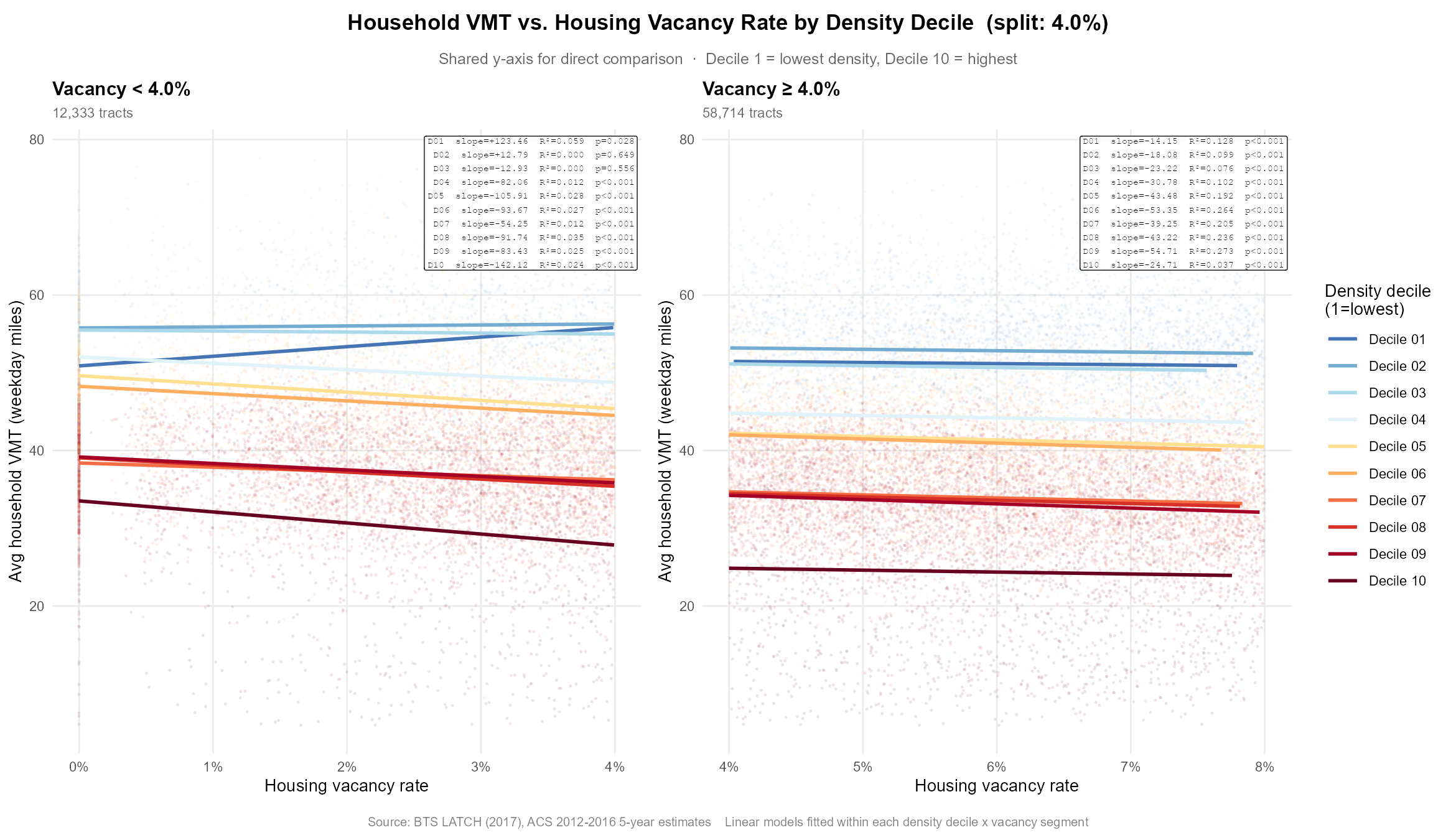
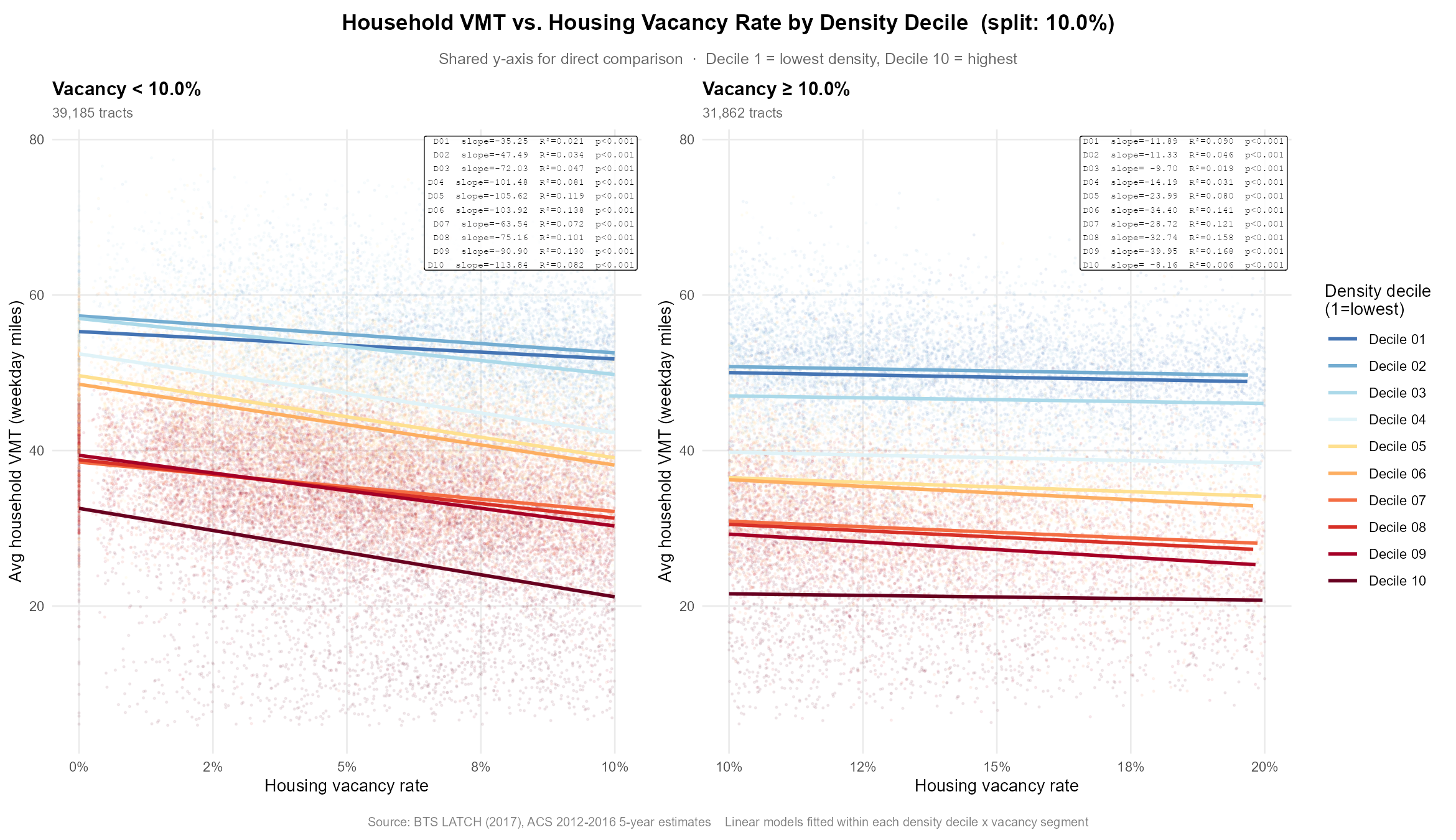
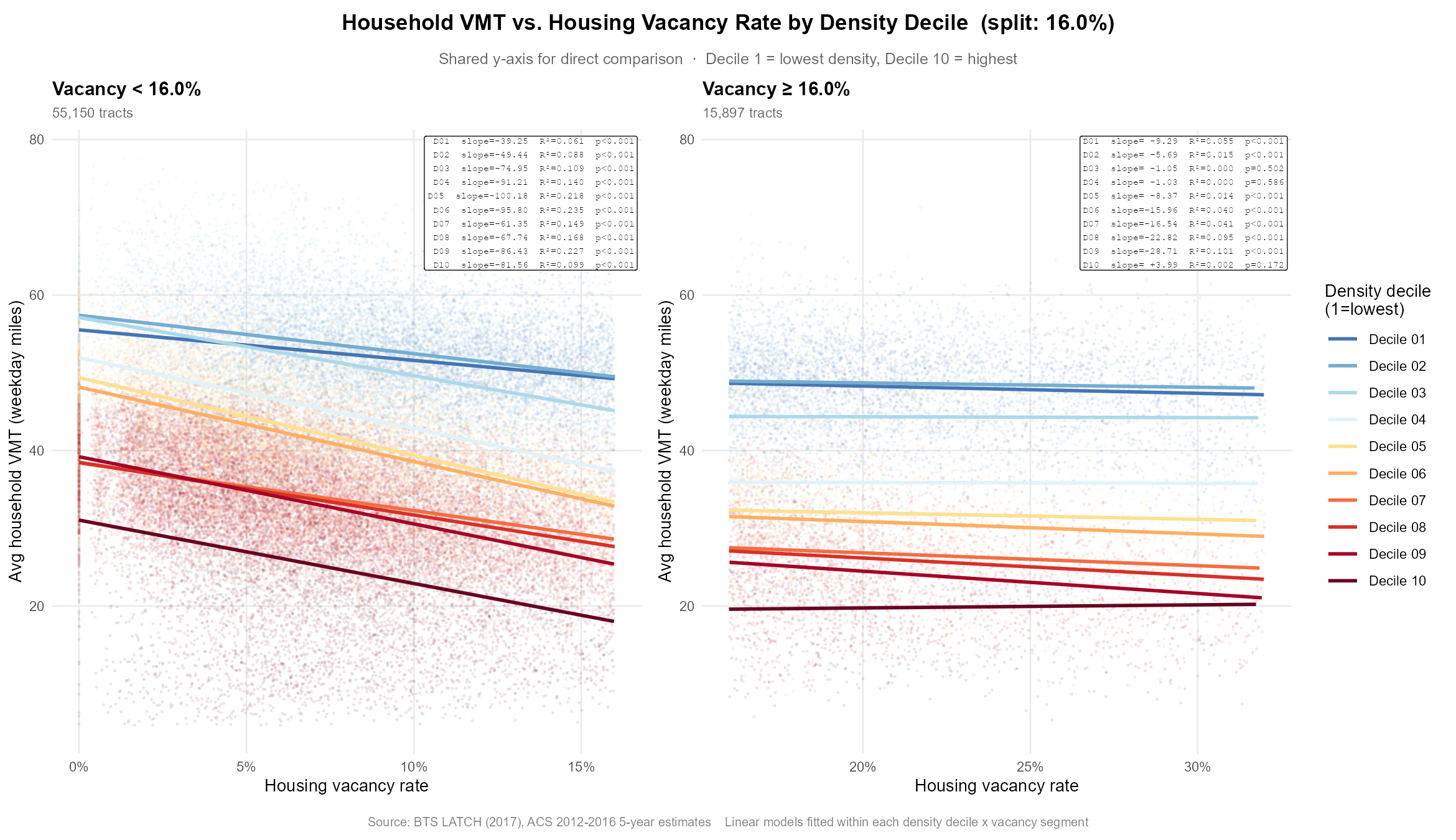
You can see that some of the models get messy at different cutoffs. There are, for instance, few low-density tracts with low vacancy and few high-density tracts with high vacancy, making models for those instances unreliable. A split at 10%, however, appears to show a strong negative relationship for tracts with vacancies below this level, and a virtually flat one for higher vacancies for most density levels. This would seem to suggest that, at vacancies below 10%, housing market pressure begins to force residents to seek a compromise between location and housing suitability, though the precise inflection point is likely different for the various density deciles.
I think these are cool initial results, but I'd also like to improve on my methodology.
It would also be helpful to bin tracts by household income to eliminate the possibility that these findings are a proxy for economic opportunity; that is, that housing vacancy and low VMT are both results of weak local economies (I do think this is plausible for tracts such as those in shrinking rural areas with extremely high vacancy).
Second, I would like to explore other VMT metrics. The BTS-LATCH dataset gives values for weekday travel at the household level, so it overrepresents commutes and does not account for household size (though this is relatively easy to adjust for). More importantly, it is itself a model, as it extrapolates from survey data (admittedly a very large survey, with 129,000 responses), meaning that these results are essentially models of a model. One way to produce reliable raw VMT might be to use DOT traffic volume data trimmed to census tracts using GIS.
Finally, I would like to account for outliers among high-density tracts, like the Manhattan example. The LATCH data do not show where people are commuting to from their respective tracts, which may understate the long commutes induced by housing shortages in urban cores, and inflate VMT for higher-vacancy neighborhoods outside of downtowns. I speculate that accounting for this could actually significantly strengthen these findings.
-ProHousing advocate Adam Cook

The new zoning is now in effect
It’s an exciting time for the future of a more affordable, livable Missoula!
At Front Step, we’ve hired a new Policy and Advocacy Manager. Dylan Wells brings a background in law, justice, and community organizing, and ProHousing Missoula work will be a big part of his role.
We’re in planning mode for the next phase of ProHousing Missoula - let us know if you’d like to grab coffee with Dylan and get involved. Get in touch: dylan@frontstepclt.org
The new Unified Development Code is now in effect.
Now through July 2, the city is in a transitional period for developers to start adopting the new code requirements. Building permits, zoning compliance, and design excellence applications all now fall under the new code.
Our ProHousing advocates took some time to read through the published code and share top takeaways.
New insights on the Unified Development Code
Many more homes and housing types are legal to build citywide.
It is now possible to build small apartments and townhouses in many neighborhoods where only 2 units per lot were allowed before.
This helps ensure that all neighborhoods address the housing shortage.
This creates a direct path to greatly improved affordability. Studies show that accelerating infill construction eases competition for existing housing, and this has the greatest benefit for the most affordable units.
New zoning controls the size and scale of buildings, rather than the number of units that can be built.
Old zoning restricted the number of units that could be built per lot.
New rules instead restrict the maximum height and floor area of new construction using a Floor Area Ratio calculation.
This allows builders the freedom to more efficiently use the space in any given lot.
The new code eliminates parking mandates.
Requiring arbitrary amounts of parking with new housing and businesses drives up housing costs.
Removing mandates allows builders to choose how much parking makes sense for a new home or business.
The new code allows small commercial spaces in all neighborhoods.
Our old zoning code harshly restricted small neighborhood businesses like corner markets and cafes. Now these are permitted.
These sorts of businesses — think Grizzly Grocery or Rattlesnake Gardens — were very hard to build.
When small businesses are allowed in neighborhoods, people don’t have to go as far to access them, which means better walkability, less traffic, and fewer emissions in our valley.
The new code is a step toward “focusing inward.”
Missoula has previously set a goal of focusing new development on existing city land, rather than sprawl into our mountains and open space.
Studies show that less land use change occurs when urban housing policies are more permissive. This means that wildlands, recreation, and agriculture are better preserved, and fire risk is reduced.
The new code helps to meet Missoula’s mobility goals.
When housing options are few and far between, people often must choose to live — and drive — far to reach work, friends, and recreation. Greater housing availability gives people the opportunity to live in their preferred neighborhood with shorter commutes and more transportation choices.
Thank you to ProHousing advocate Adam Cook for taking the time to read through the code and provide insights!
We’re excited to follow the implementation of the new code, and we encourage folks to reach out and let us know how these changes affect them, especially if you’re a homeowner or local builder!
Zoning reform update
Letter sent to Missoula City Council Jan. 12:
Dear Mayor Davis, Missoula City Council and CPDI staff,
As the Our Missoula Code Reform process enters its final stretch, we want to thank you for the extraordinary amount of work that has gone into modernizing Missoula’s land-use framework. Building on the Land Use Plan adopted last year, the City now has a once-in-a-generation opportunity to take bold steps toward our shared goals for a more affordable, sustainable, and equitable Missoula.
City staff have done admirable work shaping the Unified Development Code and responding to public feedback. We offer the amendments below in the same spirit: to ensure the final code delivers timely and meaningful increases in housing supply, mitigates sprawl and displacement, and supports compact, walkable neighborhoods where people can live, work, shop, and thrive.
Staff-Recommended Amendments We Ask Council to Reject:
While most staff-recommended amendments are improvements to the draft code, we respectfully urge Council not to adopt the following:
1. Staff Amendment #3, including Neighborhood Commercial in Floor Area Ratio (FAR) calculations. Keep it as it is in the draft. Including commercial building area in the residential FAR calculation limits the ability to build one of Missoula’s most time-tested building types: a small family-owned shop with a home above. These mixed-use buildings are key to neighborhood vitality and should be encouraged, not discouraged.
2. Staff Amendment #6, amending Floor Area Ratios. The floor area ratio recommended in the first draft of the UDC was adequate for Missoula’s urgent housing needs. We do not agree with lowering FAR to 1.2, which would limit building infill homes in existing neighborhoods.
3. Staff Amendment #20, including Neighborhood Commercial uses in FAR and modifying size limits. Neighborhood Commercial building area should not count towards the Floor Area Ratio limit. Lowering the maximum square footage in urban residential districts to 3,500 square feet while allowing it at 5,000 square feet in limited urban or rural residential districts reverses the logic that a location with a higher population nearby would see more visitors and therefore want more space.
a. Alternate proposal: Size limit for Neighborhood Commercial should be increased in all districts to 5,000 square feet. This proposal was passed by the Planning Board.
Our Proposed Code Amendments
1. Allow Neighborhood Commercial in the middle of blocks. Missoula residents have expressed strong desire for more neighborhood stores and shops near their residences. This would unlock more potential opportunities for entrepreneurship, encourage walkability and access, and give business owners the flexibility to modify or upgrade their space. This proposal was passed by the Planning Board.
2. Eliminate wasteful parking mandates for commercial buildings. This would give small businesses the flexibility to do more with their space and encourage economic growth. This proposal was passed by the Planning Board.
3. Increase height limits in Urban Residential 3 (U-R3) by 10 feet and in Urban Residential 4 (U-R4) by 5 feet. This brings the code into compliance with the maximum heights described by the Land Use Plan, which was adopted unanimously last year. Functionally, it adds the potential of one additional story above the building heights allowed by the current code, which is an appropriate and incremental change. Allowing 4-story buildings improves accessibility since elevators begin to pencil out at 4 stories, allowing each f loor to be ADA-accessible. This proposal was passed by the Planning Board.
4. Fold Civic District 1 into Civic District 2. In the interest of further simplifying the code, we think the Civic District 2 designation would be appropriate for areas that are designated Civic District 1 in the draft. Since Civic District 1 precludes housing being built, this would increase the area of the city eligible for housing. Zoning is not the best tool for restricting housing at unsuitable sites and we prefer the flexibility allowed in Civic District 2. This proposal was passed by the Planning Board.
5. Reduce landscaping percentage requirements by 5 percentage points and lift the requirement in the Downtown Transition. Additional space requirements on housing increase costs for residents and limit the ability to build on compact lots. The biggest positive environmental impact Missoula can make is by encouraging efficient, compact development. If residents are able to access alternate modes of transportation, their greenhouse gas emissions are reduced. If Missoula incentivizes compact building of homes in existing city areas, further sprawl and damage to green space and critical habitat is reduced. Suburban landscaping is not the best fit for the urban area of the Downtown Transition zone. This is a more limited proposal than Planning Board’s Motion #25.
6. Remove activity area requirements. Like landscaping requirements above, mandating the construction of private activity areas adds cost and space requirements to the compact, low-cost infill homes that Missoula needs. We believe the activity area requirements as drafted would result in infill projects that have been built no longer being viable in the future. If a project can be built, activity areas would decrease the space that could be a home. The Planning Board recommended paring down activity area requirements.
Zoning Map Amendments:
1. Change the zoning designation for corridors served by frequent transit from Urban Residential 3 to Urban Residential 4. The corridors are Johnson Street from Third to North; Catlin Street from Third to 14th Street; Arthur Avenue from Evans to South; and South Avenue from Higgins to Arthur. Increasing housing options near frequent transit meets the City’s goals to increase overall housing capacity especially near transit corridors. This proposal was passed by the Planning Board.
2. Change Urban Residential 1 (U-R1) zoning for the areas east of Paxson, north of 39th Street / Southwest Higgins, west of Lester Street and south of Benton Avenue to Urban Residential 2 (U-R2). Slightly increasing the flexibility for home types in these neighborhoods, which are well served by amenities and transit, reflects the community’s desire for equitable development in neighborhoods across town. This change would decrease the creation of nonconforming buildings in these areas.
Public Support for These Changes
In collaboration with Front Step Community Land Trust, we fielded a scientific public opinion survey in mid-November which showed broad agreement with key aspects of the UDC.
● Nearly half (47%) of residents have been personally affected by the housing shortage, and another 38% know a friend or family member who has been impacted.
● Nearly six in ten Missoulians (58%) report that this lack of affordable homes has made it difficult to imagine a long-term future for themselves in our community.
● Two-thirds (66%) of voters including a majority of homeowners (54%) believe the city should prioritize creating more homes to reduce costs, while one-third (34%) prefer the city try to protect neighborhoods from change.
● Voters favor giving businesses near downtown flexibility to set their own parking needs (66% in support).
● Respondents support permitting small neighborhood businesses on mid-block sites (64%) as well as corner lots.
● After an extensive three-year process, nearly two-thirds (63%) of voters think the UDC has been reviewed long enough and should be brought to a vote, compared to the 37% who prefer additional time and review.
● View the details and methodology here.
We are grateful for your dedication to this work. Thank you for your commitment to a more inclusive and vibrant Missoula.
Sincerely, ProHousing Missoula

Poll indicates most Missoulians support pro housing policy
Poll results indicate most Missoulians think the government should prioritize creating more homes rather than protecting neighborhoods from change.
A poll conducted in mid-November 2025 shows that as the city weighs code reform changes, most Missoulians agree that there is a shortage of affordable housing and the city should prioritize increasing housing stock and bringing down prices.
In the poll, which was conducted by an independent third-party pollster commissioned by Front Step CLT and ProHousing Missoula, Missoulians agreed that the city lacks housing at all levels of the market. Renters and lower-income residents especially agreed that the city lacks housing options.
Nearly 60 percent of responders also agreed that housing costs make it difficult for them to envision a long-term future in the Garden City.

Missoulians across several income levels agreed that the city lacks housing.
In an optional comment section, poll respondents weighed in with the deeply personal anecdotes about how housing struggle affects everyone:
“2021, landlord sold his home and moved into our rental. It took 3 months to find a place and our rent doubled and has only gone up since.”
“A friend lives in a 5th wheel started 4 years ago.”
“A neighbor's rent was increased to an unaffordable amount. He and his dog are living in his car. Heartbreaking. He's in his 60s.”
“I became homeless a year ago im now in subsidize living.”
“I literally can't afford a house. I make good money and pay no rent. But with a 20% down payment I couldn't afford a mortgage on a low-median cost house.”
These insights come at a pivotal time for the community as Missoula City Council is set to vote on a code reform package that could impact housing stock for decades to come.
Find a summary of poll results from Embold Research here, and the topline poll results here (which also contains a link to the individual responses).
For more information or to request an interview, reach us at info@prohousingmissoula.org.

ProHousing Yard Signs
ProHousing yard signs
We have newly minted ProHousing yard signs! This latest batch is glossy and UV coated to stand the test of time. Contact us to get one for yourself: info@prohousingmissoula.org